


Why businesses are choosing interim CTO vs permanent CTO hires in 2026
In 2026, more boards, founders and private equity investors are treating the CTO role as an execution lever, not just a long-term leadership appointment. That is changing how technology leadership hiring works: instead of running a traditional permanent search first, many businesses are bringing in an interim CTO to stabilise, diagnose and deliver against a defined transformation agenda. (bcg.com)
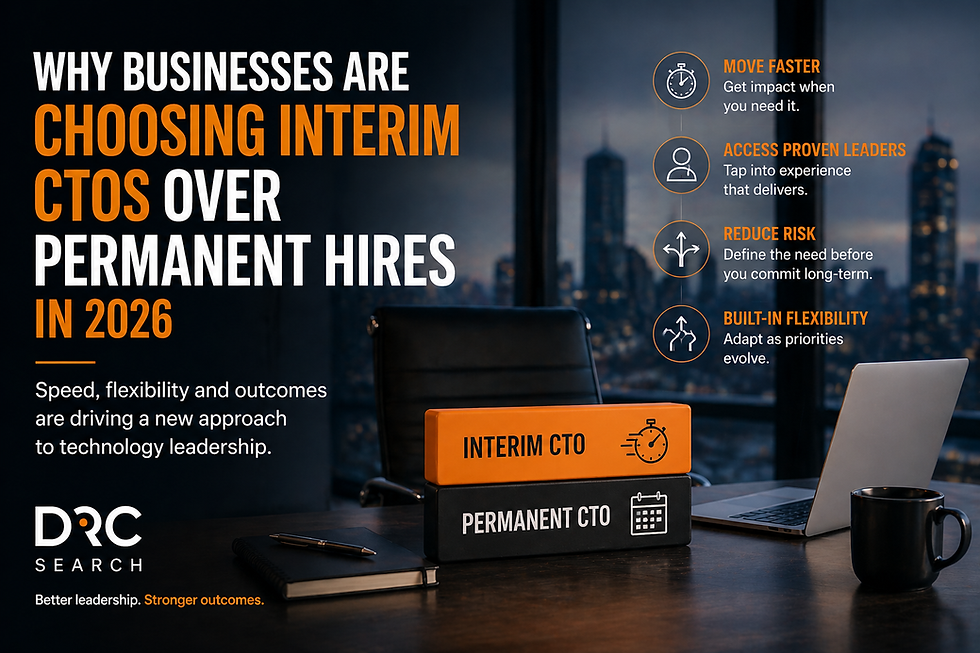
The short answer - Interim CTO vs Permanent CTO
Businesses are choosing interim CTOs in 2026 because the pressure to move quickly is higher than the tolerance for a wrong permanent hire. When the brief includes AI readiness, platform modernisation, cyber resilience, post-deal integration or engineering reorganisation, an interim CTO can often create faster clarity and lower execution risk than forcing an immediate permanent appointment. (bcg.com)
Why the shift is happening
The CTO brief is now wider than technology alone
The modern CTO brief is no longer confined to architecture and engineering oversight. According to McKinsey, enterprise technology adoption is moving from experimentation to scaling across areas such as generative AI, cloud and applied AI, while companies still face a wide skills gap across high-demand technology capabilities. That means CTOs are increasingly expected to lead business-critical change, not just technical delivery. (mckinsey.com)
BCG makes the same point from a private equity angle. Its January 2026 research found that digital transformation is now viewed as essential to AI deployment and value creation, with PE-backed companies that build cutting-edge AI capabilities across functions generating nearly twice the return on invested capital of those that do not. In that environment, sponsors do not just want a credible technologist; they want someone who can turn a value creation plan into measurable operating progress. (bcg.com)
That is one reason interim CTOs are gaining ground in executive search for PE-backed businesses. If a board is not yet certain whether it needs a scale-up platform leader, a post-merger integration operator, or an AI transformation lead, an interim appointment creates space to define the permanent role properly before launching a full CTO search UK process. (bcg.com)
Speed matters more than title permanence
The appeal of an interim CTO is often simple: speed. The Institute of Interim Management’s 2025 survey found that 33% of interims landed an assignment within two weeks, and 86% did so within eight weeks. For businesses dealing with platform risk, delayed product delivery, cyber exposure or investor pressure, that is materially faster than waiting for a permanent process to run its course. (iim.org.uk)
Interim hiring is also becoming more mainstream at the top of organisations. BRG noted that in the first half of 2025, companies hired about one-third of new CEOs on an interim basis, up sharply from the 5% to 9% range of prior years, and argued that 2026 would bring more use of interim management to fill leadership gaps, execute strategy and navigate disruption. While that data is not CTO-specific, it points to a broader board-level acceptance of interim C-suite leadership. (thinkbrg.com)
In practice, that matters because the cost of a slow decision is now higher than the cost of a temporary one. A business with an ERP reset, cloud migration, AI roadmap or major engineering restructure cannot afford six months of drift while debating the perfect permanent specification. (bcg.com)
The market is softer overall, but specialist tech leadership is still hard to hire
The broader UK hiring market is not as overheated as it was in 2022. ONS reported 723,000 UK vacancies in August to October 2025, down 12% year on year, with 2.5 unemployed people per vacancy, the loosest labour market outside the pandemic period since 2015. That should make hiring easier in theory. In practice, it mostly means companies are being more selective. (cy.ons.gov.uk)
At the same time, the most strategic technology skills remain scarce. LinkedIn’s September 2025 AI Labour Market Update found AI engineering hiring up more than 25% year on year, with AI engineering postings up 63% year on year and postings requiring AI literacy skills up 71%. PwC’s 2025 AI Jobs Barometer added that industries with high AI adoption are seeing three times the productivity growth of less exposed sectors, with an 11% wage premium attached to occupations with AI skills. (economicgraph.linkedin.com)
That combination explains a lot of 2026 behaviour. Boards may be slower to add headcount generally, but they are still under pressure to secure senior leaders who can handle AI, data, security, architecture and operating model change. An interim CTO becomes a way to access that capability immediately, especially when the permanent brief is still evolving. (economicgraph.linkedin.com)
Why interim CTOs fit PE-backed and growth businesses particularly well
The model fits sponsor-backed environments because the first 12 to 18 months of ownership are heavily execution-led. BCG found that 73% of PE firms run digital due diligence on most deals and that the most successful firms launch 100-day digital squads immediately after acquisition. It also found that only 15% of portfolio companies describe their IT capabilities as very mature. That creates a clear gap between investor ambition and operating reality. (bcg.com)
The interim market is already reflecting that demand. The IIM survey shows that PE and VC clients remained the biggest private-sector end-client type for interim assignments in 2025 at 35%. It also found that change or transformation management remains the dominant nature of interim assignments, while pure gap-filling assignments are just 7%, down from 18% in 2010. In other words, interim executives are increasingly being hired to change businesses, not merely cover absences. (iim.org.uk)
That is especially relevant in technology leadership hiring. Many portfolio companies do not initially need a permanent visionary CTO; they need someone to sort out delivery discipline, reduce platform risk, set a realistic roadmap, and help investors understand where technology can genuinely create value. The permanent hire often comes after that reset. (bcg.com)
Where businesses are using interim CTOs in 2026
Common use cases
An interim CTO is most attractive when the business problem is time-bound and commercially urgent. In 2026, the pattern is most visible in four situations:
1. Post-deal or post-fundraise stabilisation
Sponsors want clarity on systems, data, cyber exposure and engineering capability quickly. (bcg.com)
2. AI and data readiness
Boards need practical leadership that can move from pilot activity to operating discipline and governance. (mckinsey.com)
3. Scaling engineering teams
Growth businesses often outgrow a founding technical structure before they are ready for a long-term enterprise-style CTO. (drc-search.com)
4. Creating a better permanent brief
An interim leader can help define whether the eventual permanent need is a CTO, VP Engineering, CPO search, or even a commercially weighted technology leader that overlaps with CRO search considerations in product-led businesses. That avoids forcing the wrong org design too early. (drc-search.com)
Interim is not always the right answer
Interim CTOs are powerful, but they are not automatically low risk. Harvard Business Review has recently argued that interim leadership appointments can unsettle stakeholders if the mandate is unclear or the context is misunderstood. The lesson for boards is straightforward: interim works best when the outcomes are tightly defined, authority is explicit, and the business knows what success should look like in 90, 180 and 365 days. (hbr.org)
If the real need is long-term culture building, deep succession planning, or a multi-year product and technology identity, a permanent search is still the better answer. The mistake is not choosing interim; the mistake is using interim to avoid making a decision. (hbr.org)
What this means for boards and investors
The underlying shift is that businesses are separating two decisions that used to be bundled together: what needs fixing now, and what long-term leadership model the business needs next. That is a healthier approach. It reduces the odds of hiring a permanent CTO into an unclear brief and increases the odds that the eventual hire is matched to stage, strategy and investor expectations. (bcg.com)
For companies thinking beyond the interim phase, useful starting points include DRC Search’s resources on CTO executive search, technology executive search and hiring guides, and fintech executive search. They are most useful once the business has translated the immediate technology problem into a clear long-term leadership mandate. (drc-search.com)
Key takeaways
Interim CTOs are being hired to drive change, not just provide cover. (iim.org.uk)
AI, data, cyber and platform complexity have made the permanent CTO brief harder to define upfront. (mckinsey.com)
PE-backed businesses value interim CTOs because they align with 100-day plans and fast value creation. (bcg.com)
The right interim model can improve a later permanent CTO search UK process by clarifying outcomes before the search begins. (bcg.com)
Interim works best when the mandate is specific, time-bound and tied to commercial results. (thinkbrg.com)
DRC Search works with private equity-backed and high-growth businesses to deliver senior leadership hires across CTO, CRO and CPO mandates.
Interim CTO vs Permanent CTO



Comments