


Why Companies Are Struggling to Hire Experienced AI Leaders in 2026
AI hiring has moved beyond experimental data-science roles. In 2026, boards and investors want leaders who can turn AI into revenue growth, operating efficiency, product improvement and better decision-making without losing control of risk, governance or cost. That sounds straightforward, but the market for people who have genuinely done all of that at scale is still very small. (mckinsey.com)
The pressure is even sharper in private equity and high-growth environments. PE-backed businesses are being asked to move quickly, prove value fast and build repeatable capability, which means they are not hiring for AI theory; they are hiring for execution. Bain’s 2025 private equity research shows most portfolio companies were still in testing and development, while only around one in five had operationalised generative AI use cases and started to see concrete results. (bain.com)
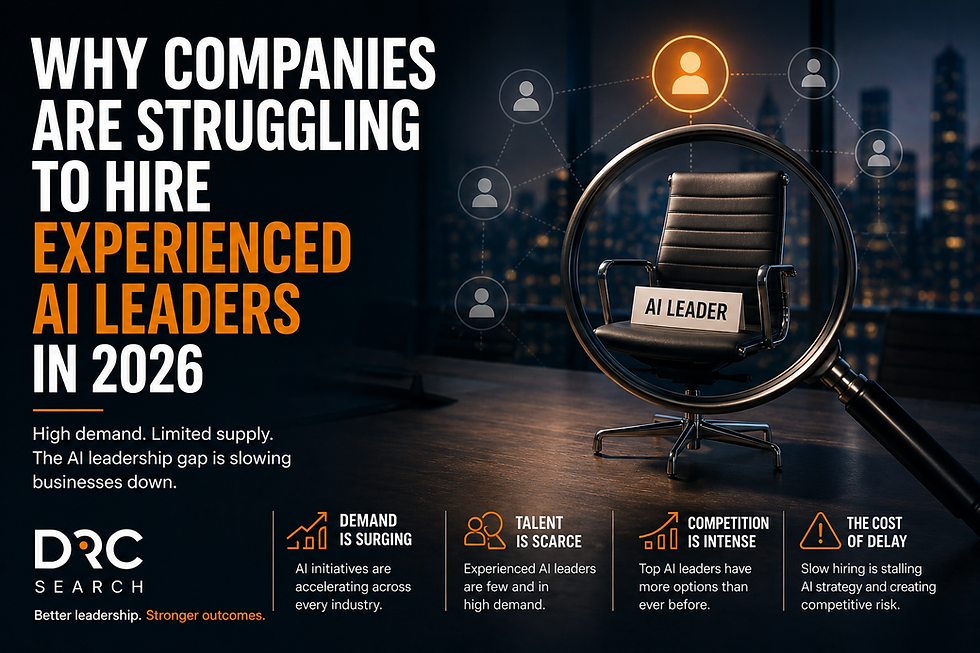
In short - Hire Experienced AI Leaders
Companies are struggling to hire experienced AI leaders because the brief is tougher than the talent pool. The strongest AI leaders in 2026 need technical credibility, commercial judgement, governance discipline and change-management experience, but very few executives have built that mix in a live operating environment. (bain.com)
The supply of proven AI leaders is still genuinely thin
According to Bain & Company, AI-related job postings have grown by 21% a year since 2019, compensation for AI skills has risen 11% annually, and 44% of executives say a lack of in-house expertise is slowing AI adoption. That is the core hiring problem in one data point: demand has accelerated much faster than the number of leaders who have delivered AI outcomes inside real businesses. (bain.com)
LinkedIn’s Economic Graph has made the same point from a European talent perspective. LinkedIn reported in January 2025 that AI talent made up just 0.41% of EU workers, and its September 2025 labour-market update showed AI engineering talent still accounts for less than 1% of LinkedIn members while AI engineering job postings represented nearly 7% of technical job postings, up 63% year on year. In other words, employers are not competing over a broad market; they are chasing a narrow one. (linkedin.com)
That shortage is especially visible in the UK and Europe. Tech Nation’s UK AI Sector Spotlight 2025 found the UK AI sector had reached a combined market valuation of $230 billion, with UK AI startups raising $1.03 billion in Q1 2025 alone, yet founders still identified access to capital and talent as their biggest barriers to growth. Strong demand plus limited experienced supply is exactly why senior AI searches take longer than boards expect. (technation.io)
The role is still badly defined
A large share of the market is struggling because companies say they want an “AI leader” when they actually mean four jobs at once: platform builder, product strategist, governance owner and internal change agent. McKinsey’s 2025 global AI survey found organisations are putting senior leaders into critical governance roles, and that CEO oversight of AI governance is one of the factors most correlated with higher self-reported bottom-line impact from generative AI. This is no longer just a technical appointment. (mckinsey.com)
Many briefs combine research, product, governance and transformation
In practice, that means the best candidates are often rejecting roles that lack clarity. Deloitte found 67% of leaders were increasing generative AI investment in 2025, but 68% said 30% or fewer of their experiments had moved fully into production. The same study found three of the top four barriers were risk-related, including regulatory compliance concerns, difficulty managing risk and a lack of governance model. If the business has not defined what success looks like, strong candidates will assume the role is under-scoped or politically exposed. (deloitte.com)
PwC’s 2025 Responsible AI Survey reinforces that point. It highlights unclear ownership as a barrier to operationalising AI governance, while 56% of executives say first-line teams such as IT, engineering, data and AI now lead responsible AI efforts. That shift sounds positive, but it also means many organisations are still working out where decision rights should sit between technology, legal, risk and the business. Experienced AI leaders know that ambiguity becomes their problem on day one. (pwc.com)
The market wants operators, not AI evangelists
The strongest candidates are not just people who can explain large language models to a board. They are people who have shipped products, redesigned workflows, improved commercial performance and put governance in place while the business kept running. McKinsey reports that more than three-quarters of organisations now use AI in at least one business function, but only 21% of respondents using generative AI say they have fundamentally redesigned at least some workflows. That gap matters: companies do not need more AI enthusiasm; they need leaders who can change how work gets done. (mckinsey.com)
This is why experienced AI leadership often overlaps with broader technology leadership hiring. In PE-backed and scale-up environments, the brief increasingly sits somewhere between a transformation CTO, a product-led operator and a commercially literate business builder. That is also why CTO search UK, CPO search and even CRO search mandates are starting to intersect more often: AI value is now showing up in product, pricing, customer support, sales productivity and operating margin, not only inside the engineering function. (bain.com)
PE-backed businesses face a sharper version of the problem
For executive search for PE-backed businesses, speed is only part of the issue. The harder challenge is finding leaders who can balance urgency with discipline. Bain’s private equity research shows the firms getting ahead are adding AI talent, setting governance protocols and helping portfolio companies apply AI to strategic priorities rather than treating AI as a strategy in itself. That is a very specific leadership profile, and there are not many executives who have done it across portfolio-style value creation. (bain.com)
The ECB’s 2026 evidence on euro area firms also matters here. It found that firms investing in or using AI intensively are not, at this stage, replacing jobs wholesale; some are actually hiring more as they implement AI and scale. That means the best AI leaders are being hired into growth and transformation mandates, not cost-cutting-only mandates, which again narrows the available pool to executives who can build teams as well as tools. (ecb.europa.eu)
What better hiring looks like in 2026
The companies making better hires are tightening the brief before they go to market. They define whether they need an enterprise AI governor, a product-commercial AI builder, or a technology leader who can embed AI across the operating model. They also align the role with stage: founder-led scale-up, post-Series B platform business and PE-backed carve-out all need different kinds of AI leadership. That is basic search discipline, but it is still missed surprisingly often. (mckinsey.com)
For that reason, businesses should treat AI hiring as part of broader technology executive design, not as a standalone prestige hire. DRC Search’s perspective on CTO executive search and its technology leadership hiring guide both reflect the same practical issue: once engineering teams scale, technology strategy becomes central to growth, investors expect board-level technical leadership, and role definition becomes decisive. (drc-search.com)
The same logic applies in adjacent mandates. AI increasingly changes how product is prioritised, how commercial teams operate and how regulated sectors such as fintech scale. That is why CPO search, CTO search UK and fintech executive search briefs are becoming more interconnected, particularly where leadership teams need to translate AI capability into customer value and revenue outcomes. (drc-search.com)
Key takeaways
The talent gap is real, not anecdotal: demand for AI leadership has risen faster than the supply of proven operators. (bain.com)
Many companies still write AI leadership briefs that combine multiple jobs into one, which deters the best candidates. (deloitte.com)
The market increasingly values leaders who can operationalise AI, manage governance and drive commercial outcomes, not just technical specialists. (mckinsey.com)
In PE-backed businesses, AI leaders are being hired to accelerate value creation with control, speed and focus. (bain.com)
Better hiring starts with a sharper mandate and a clearer view of where AI leadership should sit in the executive team. (drc-search.com)
The companies that win this market are usually not the ones with the biggest headline ambition. They are the ones with the clearest brief, the most realistic expectations and the strongest understanding of how AI changes leadership requirements across technology, product and revenue functions. In 2026, that is what separates stalled searches from successful ones. (mckinsey.com)
DRC Search works with private equity-backed and high-growth businesses to deliver senior leadership hires across CTO, CRO and CPO mandates.



Comments